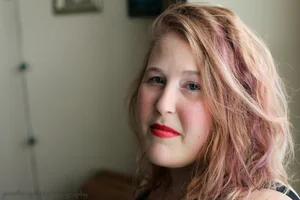
The Spiraled Roar
Originally published on Substack in July 2025
“I’m probably going to have to mind map this,” I tell Melissa, my best friend, over a voice note. My mind has been orbiting around disparate thoughts for weeks now, but I know they connect. I feel into the way they bend and sway in my mind, hoping for clarity. This is why I’m sending her a message. I need to find their connective tissue.
I do mind map. I begin with what feels central, and then move from there, my frustration growing because everything—and I do mean everything—feels interconnected. Before long, I’ve created a veritable conspiracy board, arrows pointing and swirling across the page toward their targets.
Why doesn’t this ever work for me? I write in the margins. I feel more tangled than before, my footing unsure. And then it hits me: I’ve never been one to outline or plan when it comes to writing. My words form spirals vs straight lines, and in order to find this flow I have to allow them to fall as my brain rushes to keep up, forming connections as the sentences turn into paragraphs. I’m like this with the characters in my books, the plots that reveal themselves on the page, and my life.
And so I do what I always do: I start to write.
I’m scrolling through TikTok when I see something that makes me pause. It’s a video on Scorpio Risings and the contradictory nature of their Leo Midheaven. Not every Scorpio Rising has Leo in their 10th house, but this Scorpio Rising does and alongside my 12th house stellium, it’s one of the pieces of my chart that befuddles me daily. It truly feels like oil and water, at least to me—and I also happen to have a Leo stellium. Being seen should feel like second nature.
But being seen terrifies me.
I think of the ways in which I started sharing myself online. How my heart pounded every time I hit publish. How I slowly became more comfortable with peeling back the curtain into my psyche until things crashed around me and my entire foundation—what I thought I knew—fell like the Tower. I tried to write about it. I succeeded for a good while. And then one night I was on the phone with a family member and he said, “hey so you might want to be careful about what you write about online. People might think you lived a life of turmoil.”
As if that wasn’t true.
As if him warning me about this wasn’t indicative of the very turmoil I was parsing through on my blog.
I’d been skirting around the topic for months—how I had recently had memories resurface that knocked me off kilter. I never mentioned names, but it didn’t matter. The people these posts were about had read them with their own filter of history and knew I was talking about them. And so, the warning. I’ll never forget that conversation. I’ll never forget the way the sun tried to break through our blackout curtain we had over the window or the way my heart started racing out of fear or how our dog’s tail thumped rhythmically against the wall in anticipation. I caught her gaze and she sniffed and fell against the ground on her side, almost as if she heard the conversation and was categorically dismissing the admonishment. I sat down next to her as I finished talking on the phone, my hand on her side feeling her breath move underneath me.
In, out.
In, out.
It was a reminder. A benediction.
A few months later I’m edging against the truth in another blog post, but this time it’s not about family, but about the church where we’ve been partners since before these memories resurfaced. I’m writing about shame. I’m writing about how words mean things. I’m writing about elders in the church saying that those who’ve experienced sexual abuse should and would feel shame and guilt about their abuse—and subsequently, we’ll need to have conversations with them around repentance.
I’m in a gospel counseling class.
I push back, horrified at the suggestion that those who’ve experienced abuse will have to repent of anything related to the violation.
My words are unheard, and so I write, and so comes another warning.
Like before, I don’t mention the name of anyone. I don’t specify that my story is about church. All I share is that I’m in a class and given the writers on the board of that particular site, it could have been any Christian university in the world. It doesn’t matter. I have messages from friends and women within the church who are worried about my heart. I’m called names like divisive and accused of making up lies so that I can clout chase. They demand I take the post down. I refuse. They say words like libel and responsible. I am invited to coffee. I walk around in a trance, triggered once again, my limbs numb from what my nervous system fears is an impending attack.
I don’t know until later that I am already in it.
I don’t know until later that what I am feeling: the racing heart, the blurred vision, the brain fog, the heavy limbs—it’s textbook C-PTSD.
It takes me at least a month to be able to even think about writing on my blog again.
I’d forgotten about these moments until I started seeing sound bites of the contradictory nature of Leo Midheavens.
“It can be hard for you to be seen,” the person says into the camera, “because you have wounds around visibility.”
I laugh to myself.
Oh, I think.
Because it’s not just the examples above. It’s being celebrated for my leadership only to have it turned on me as a threat. It’s pursuing my dream of fostering a writing community only to be labeled a wolf in sheep’s clothing.
It’s having the same amount of Instagram followers for a decade—even though I’ve been doing everything my peers in the publishing industry are doing.
It’s barely hitting $100 in royalties for my books even though I’m literally talking about them all of the time on social media and have invested money in marketing campaigns.
It’s watching others do less, but get so far more in return.
It’s knowing that this post will probably either be lost in the algorithm or somehow be ostracizing in how it’s received. And I don’t mean for it to be—but somehow, that fear always inches closer and closer when I’m sharing a piece of myself online.
And that fear, when left unchecked, can be hard to swallow.
I tell Melissa in my voice message that there’s a through line in these disparate thoughts about social media. Maybe that’s the spiral—my place in it all. “Sometimes I can’t even hear myself think because I’m so focused on everyone else or getting my thoughts into a digestible sound bite,” I tell her. She agrees, and invites me to consider what that might mean.
She’s had her phone in airplane mode for a few weeks now and tells me she doesn’t even miss it—that she used to do this often in order to ground. “I’m so much less anxious,” she tells me.
And it makes sense. I feel it too as I try to extricate myself from the machine. I don’t know what will happen. I don’t know how it will remotely help my book sales. But I know something has to change.
I pull cards and am reminded in no uncertain terms that I am not here to do things like everyone else; and that when I try, that’s when I begin to feel stuck.
The 8 of Cups stares back at me, inviting me to that different way. I sit in the quiet, the blinking cursor in front of me, and wait for the words to come.